

Sri Jayewardenepura Kotte, but Colombo is the commercial capital
Republic
Sri Lankan rupee (LKR)
Total: 65,610 km2
Water: 870 km2
Land: 64,740 km2
20,064,776
Sinhala (official and national language) 74%
Tamil (official and national language) 18%
Other 8%
English is commonly used in government and is spoken competently by about 10% of the population
Buddhist 70%, Hindu 15%, Christian 8%, Muslim 8%
Sri Lanka, formerly known as Ceylon, is in Southern Asia. It is an island country in the Indian Ocean, south of India. The Sinhalese arrived in Sri Lanka late in the 6th century BC, probably from northern India. Buddhism was introduced beginning in about the mid-3rd century BC, and a great civilization developed at such cities as Anuradhapura (kingdom from c.200 BC to c.1000 AD) and Polonnaruwa (c.1070 to 1200). Other notable but relatively more recent kingdoms are Dambadeniya, Yapahuwa, Gampola, Kandy and Jaffna Kingdoms.
Occupied by the Portuguese in the 16th century and by the Dutch in the 17th century, the island was ceded to the British in 1796, and became a crown colony in 1802. As Ceylon, it became independent in 1948; the name was changed to Sri Lanka in 1972.
The advantage of Sri Lanka as a tourism destination is threefold. Firstly it is an authentic tourism destination. Secondly it is a compact island of 65,610 sqkm where a tourist can travel the length and breadth of the country within a few days, thirdly the diversity of the tourism product is unparalleled.
Not only that, palm-fringed beaches are never far away and lush mountainous greenery beckons further inland. It’s clear why Marco Polo proclaimed Sri Lanka as one of the best islands in the world.
For the simplicity of communicating the diversity of Sri Lanka in 2010 the tourism authorities started positioning the country around 8 different products namely; beaches, heritage, wildlife, scenic beauty, mind and body wellness, festivals, sports and adventure and Essence. The Essence of Sri Lanka include what is unique to the country such as its people, art and culture, spices, tea, gems, handy crafts etc.
Since Sri Lanka is a tropical country, you can expect the rain anytime of the year in most parts. However, the two major rainy seasons are North-East monsoon (October to January) and South-West monsoon (May to September). Being an island, the climate of Sri Lanka changes dramatically from one part of the country to another. For example at Nuwara Eliya, in the hills of Central Sri Lanka, has a temperature around -5-20 C throughout the year, whereas Hambanthota, located in the dry zone, has a temperature consistently around 30-35 C.
High season is in Sri Lanka from December to the end of March, when the west and south coasts and central highlands are the best weather and also the least raining. However, I think it is possible to find a corner in Sri Lanka at any time where it will be nice and sunny.
The average air temperatures in Sri Lanka are between 30 and 35 ° C. In mountain areas, expect approx. 10 degrees lower air temperature than in the lowlands. At night in the mountains, the temperature can fall below 10 ° C, if you want to visit the mountains, do not forget to warmer clothes (in February I had only shorts and sweatshirt and I was quite cold). The air humidity in Sri Lanka is in the range of 70% to 90%, so the classic Central European after leaving the plane it feels like in the laundry. Ocean temperature is favorable all year round and throughout the year has almost constant temperature and a pleasant 28 ° C; I would just point out that the water in the monsoon season may not be clear.

Known throughout the world as the land of the smiling people, the friendliness and the hospitably of Sri Lankans are renowned world over and rightly so. Whether Sinhalese, Tamil, Muslim or Burgher, Sri Lankans are always courteous and willing to make your stay in their country an enjoyable and memorable one. You will be greeted with a warm blessing, ‘Ayubowan’ the moment you arrive and have all your needs taken care of. Years of hardship during the civil war and after the devastating tsunami which occurred in 2004 failed to wipe the smile out of Sri Lankan faces. With peace returning, the beautiful country is becoming the tourist paradise it used to be.
A teardrop-shaped island cast adrift in the Indian Ocean, Sri lanka is filled with cultural and natural treasures. Sri Lanka has an honorable history that goes well beyond 2000 years! Some of the ancient cities still hold the splendor of these historic monuments and buildings, most having earned the title of world heritage sites. Indians, Portuguese, Dutch and British have all left their marks here, making for a delightful mix of ancient cities, monuments and grand colonial architecture.
The most visited would have to be Sigiriya Rock, built as a fortress by an olden day King and also considered the eighth world wonder! Dambulla Cave Temples and Polonnaruwa are other sites which hold great prestige and historical value. The ancient city of Anuradhapura offers such interesting dagobas (Pagodas), beautiful palaces with moonstones and guard stones.
Sri Lanka is one of those places where history seems to fade into the realm of legend. Sri Lanka’s second highest mountain, Adam’s Peak is said to be the very place where Adam set foot on earth, having been banished from heaven. Meanwhile buddhists claim it is Lord Buddha’s footprint itself on Sri Pada which was placed in his final visit to the island.
Not only that, palm-fringed beaches are never far away and lush mountainous greenery beckons further inland. It’s clear why Marco Polo proclaimed Sri Lanka as one of the best islands in the world.
Sri Lanka is a country with a unique and a proud historical record of a great civilization, a culture of achievements, spanning over a period of several centuries before and after the birth of Christ, which by comparison cannot be second to any contemporary civilization that existed in the world.
The Cultural Triangle has brought Sri Lanka’s history alive in the most enthralling manner for millions of travelers. It covers the north central towns of Anuradhapura, Polonnaruwa, Sigiriya and Dambulla where extensive archeological ruins provide a glimpse into the island’s history, dating back to the 4th century BC. It is here that Sri Lanka’s kings developed remarkably advanced civilizations. The extensive archeological ruins of the Cultural Triangle are now protected by UNESCO as World Heritage sites. The central plains have low rainfall and several hotels are sumptuous enough to provide a holiday in their own right.


Sri Lanka is extremely rich in terms of culture. With festivals taking place all throughout the year, there is a never ending stream of joyful occasions filled with song, dance and laughter. There is full year long calendar of religious and social events. Nearly all major festivals take place or are celebrated on full moon days. Full Moon days are especially significant for this Buddhist country and every month on the day of the full moon (Poya) there is a public holiday. The Esala Festival is usually held in July/August in the ancient hill capital of Kandy. Great processions parade the roads of this beautiful city which was the last standing kingdom of the country, magnificently garbed elephants, fire walkers, Kandyan dancers, spinning plates, all to honor the Sacred Tooth Relic of The Buddha. Crowds throng the parade routes and for a tourist the experience can result in a kaleidoscope of different rituals, customs and colors. Vesak is another prominent festival which is celebrated with high enthusiasm and careful preparations.


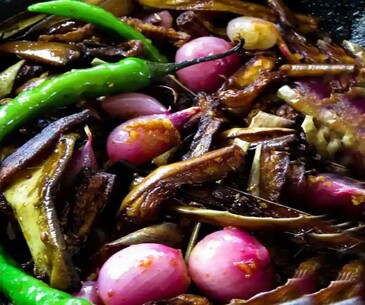
Sri Lankan food includes a lot of naturally vegan options thanks to the use of coconut oil and coconut milk. Following a vegetarian or vegan diet is fairly easy on the island as long as you choose traditional Sri Lankan dishes. If you are on a gluten-free diet, it also shouldn’t be a problem. Not only is rice the most popular choice of carbs, but rice flour is actively used in baking and making sweets. Spices are another essential ingredient in any Sri Lankan kitchen. Some of the most popular spices are chili powder, turmeric, mustard seeds, fenugreek seeds, cinnamon, cardamom, and cloves. Curries are usually prepared with one of the two curry blends: roasted curry powder (for meat and fish) and raw curry powder (vegetables and lentils). Fresh karapincha (curry leaves) gives Sri Lankan curries their distinct aroma.

Because 1866, Sri Lanka incorporates been well-known for its tea plantation that was started off by James Taylor, a Scotish planter. Central hills of the region starting up versus Hatton, Bogawanthalawa, Dickoya in direction of Nuwara Eliya, practically each individual large enhanced city in just the place is coated with a layer of Sri Lankan high-quality top quality tea plantations.


Throughout history, Sri Lanka has been known as a land of gems. King Solomon was said to have procured a great ruby for the Queen of Sheba from Ceylon. Marco Polo wrote of wonderful Ceylon gems. The Blue Sapphire is king of Sri Lankan gems. The 400-carat blue sapphire named "Blue Belle" which adorns the British Crown, is from Sri Lanka. The beautiful star sapphire named "The Star of India" which is displayed at a New York’s Museum of Natural History. Besides these sapphires, the Ilama soil also bears cat’s eyes, alexandrites, aquamarines, tourmalines, spinels, topaz, garnets, amethysts, zircons and variety of other stones. Sri Lanka, the island known as the pearl of the Indian Ocean lives up to its nickname as a hotbed for a variety of gems. Sri Lanka is home to almost 40 varieties of gems out of 85 varieties available in the whole world. Gems of Sri Lanka have found their way to many a court all over the world since time immemorial. At the gem museum visit you can have a broader knowledge about valuable gems in Sri Lanka.

Wood Carving is a form of working wood by means of a cutting tool (knife) in one hand or a chisel by two hands or with one hand on a chisel and one hand on a mallet, resulting in a wooden figure or figurine, or in the sculptural ornamentation of a wooden object. The phrase may also refer to the finished product, from individual sculptures to hand-worked moldings composing part of a tracery. The making of sculpture in wood has been extremely widely practiced but survives much less well than the other main materials such as stone and bronze, as it is vulnerable to decay, insect damage, and fire. It therefore forms an important hidden element in the art history of many cultures. [1] Outdoor wood sculptures do not last long in most parts of the world, so that we have little idea how the totem pole tradition developed. Many of the most important sculptures of China and Japan in particular are in wood, and the great majority of African sculpture and that of Oceania and other regions. Wood is light and can take very fine detail so it is highly suitable for masks and other sculpture intended to be worn or carried. It is also much easier to work than stone.

Over the past several decades the Indonesian art of batik making has become firmly established in Sri Lanka. Batiks incorporate fascinating motifs and colours, some traditional others highly contemporary and individual, but they all display a vigorousness of design unique to the island. The material created by the batik-makers is used to produce distinctive dresses, shirts, sarongs and beachwear ideal for tropical climes. Many tourists at seaside resorts such as Hikkaduwa; wear batik clothes throughout their holiday. Apart from clothes; Handmade Batiks, Table Clothes, Wall Pictures, Beach Clothes, Pure Cotton & Silk, Mens & Ladies Wears, Bed Covers are popular as a reminder of a visit to Sri Lanka. The process by which batik is produced consists of the multiple waxing and dyeing of cloth. First, the desired pattern is drawn on a plain piece of material. Molten wax is then applied to those areas of the cloth that are not to be dyed. Next, the material is immersed in the required dye and washed when the colour has set. If more colours are desired, the process of waxing and dyeing has to be repeated. Originally when batik making was a cottage industry, one artist created the entire batik from start to finish.

Masks were an essential feature of Sri Lankan rites and festivities during a time when people worshipped trees and animals. They are now more of an intriguing curiosity than they were centuries ago. The traditional mask industry, on the other hand, is still a booming business that fascinates both locals and visitors alike. Traditional Sri Lankan masks are usually spotted gracing the walls of local dwellings, with their colorful facades, strange shapes, and unique histories. They're also great as a keepsake. All of the masks have ugly traits that add to their allure. The majority of masks have gaping, deformed lips, frightening, bulging eyes, and vibrant colors. Local masks can be classified into numerous groups based on their intended usage.